Lahmeh b'Ajeen
The Taboon, Lahm bi Ajeen, and the Semiotic Dialogue of the Palestinian Hearth
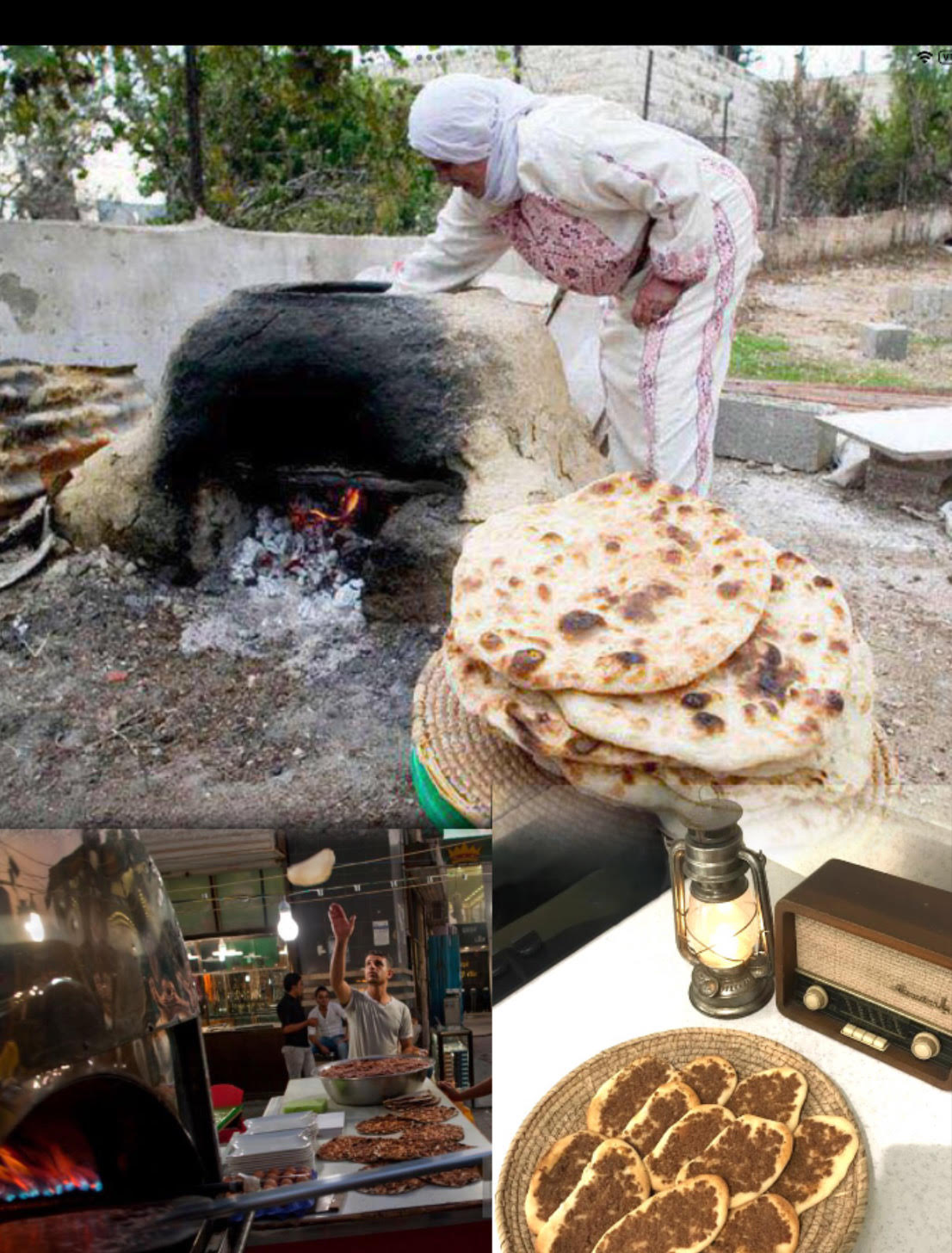
The Taboon, an enduring, native Arab invention, is far more than a rudimentary oven; it is the architectural embodiment of fire's phenomenology—an ancient crucible where inert materials is transformed into an olfactory and ontological presence. Dating back to the pre-Biblical eras (c. 7500 BC), this truncated clay dome, fashioned from the elemental triad of clay, sand, and straw, represents an early and sophisticated mastery of thermal dynamics.
The Architecture of Authenticity: Terroir and Technique
The Taboon's genius lies in its reliance on wise heat storage rather than direct flame. Fuel, often dried animal dung, is ignited either around the clay shell or within the cavity beneath, allowing the heat to deeply saturate the pebbled foundation. This method of reverberated thermal baking yields a loaf that bears the spirit of labour and is imbued with the terroir of the land—the volatile compounds of olive oil, the structured carbon of the smoke, and the sensory pulse of communal existence. The resulting bread, which bears the seal of the pebbles on its crust, becomes a material archive of Palestinian identity, setting a benchmark that even advanced technology has failed to surpass. Authenticity remains the superior paradigm, where simplicity affords boundless creativity.
The Ontological Hearth: The Culinary Hegemony of the Grandmother( Teta)
The Taboon’s cultural designation as the "Women's Oven" is a profound philosophical marker. It asserts the Culinary Hegemony of Teta (the Grandmother)—a soft, knowledge-based dominance rooted in inherited memory, not coercion. The Grandmother (Teta) is the archival memory of the soil and the cultural engineer of the kitchen. The Taboon, for its part, is the bakery of living masterpieces, a sacred chamber where simple dough enters raw, colourless, and silent, and emerges transformed—golden, aromatic, and alive. It carries within it the essence of our Palestine, as if the earth itself were baking stories into every crust.
Lahm bi Ajeen: A Semiotic Culinary Palimpsest
Among the distinct creations birthed from this sacred chamber stands Lahm bi Ajeen (Meat with Dough). This delicacy functions as a profound culinary palimpsest, revealing the layered history of the Greater Levant. Its lineage traces not merely to the Arab world, but to the wider Anatolian and Mesopotamian crucible—the Lahmacun of Armenian and Turkish origin. Its diffusion across the Fertile Crescent serves as a prime case study in gastronomic migration and cultural domestication.
The dish operates as a Semiotic Transporter—a dynamic conversation between places and people, woven through the rhythm of shared recipes. As it traveled, Lahm bi Ajeen functioned semantically, absorbing and expressing the identity of each locale, evidenced by its regional naming conventions (Aleppian, Tripolitanian, Mosulian). This phenomenon—where a single culinary template is regionally modified and named for its host—is a textbook example of geo-culinary re-articulation. It is a dialogue of dough and fire, creating an endless hermeneutic exchange between cultures that meet, intertwine, and leave traces in one another.
The Palestinian Signature and Philosophical Belonging
The Grandmother's philosophical ingenuity is most evident in her Wise Incorporation of this external culinary influence. While the Anatolian heritage provided the foundational blueprint, it was her acumen that executed the Ontological Re-shaping within the Palestinian kitchen. The fundamental transformation is marked by the addition of pomegranate molasses—a ruby sweetness woven into the Palestinian soil for millennia. This molasses is not merely a flavouring; it is a Semiotic Marker that severs the tie to the dish's geographical origin and anchors it firmly within the local terroir. It transforms an "Anatolian pizza" into a deeply rooted statement of belonging.
The pairing of the fire-kissed, crispy crust (born of the Taboon) with the spiced, tangy-sweet meat is more than a mere flavour profile; it is a phenomenological moment of collective memory. It serves as an example of how non-linguistic cultural artifacts—specifically, prepared foods—act as a mnemonic and unifying force, testifying to shared histories that defy contemporary political fragmentation. Lahmeh b’Ajeen is a lingering musical note born from the hearth, carrying the petrichor of soil nourished by rain and sun, a taste of art—an affirmation that the heart of the Palestinian kitchen pulsates on the shared, ancient rhythm of the wider Levant.