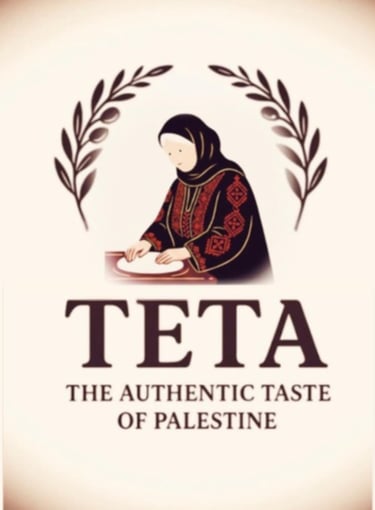
🌿 Teta
The Palestinian Cuisine as an Unconquerable Archive – Memory on thePalate
'Teta' (The grandmother of Palestine) is the home of home, the very archetype of warmth. She is not merely a purveyor of Palestinian fare; she is, instead, an aesthetic and ethical declaration. In Teta’s cuisine, we translate the ethereal threads of memory and loyalty into the visceral, tangible reality of food. In an age where identity is often challenged, we champion the Palestinian kitchen's unconquerable sanctuary as a locus of sacred archive—a repository of scents, flavours, and shared narratives that sustain the continuity of traditions and origins.
The Eternal Value of Palestinian Cuisine
At Teta, we revive the spirit of authentic Palestinian cuisine not merely as a collection of recipes, but as an expression of belonging...
We cook not only to eat, but to ultimately, remember.
Palestine, today, stands as a symbol of human and cultural resilience. Its cuisine- characterised by its richness, generosity, and profound roots, embodies the very essence of unity and congregation. The Palestinian table functions as a historical nexus, where generations convene, bound not just by the act of nourishment, but by dishes that possess deep roots in both familial and socio-historical consciousness.
Our mission is not driven by profit, but mainly by a historical & cultural responsibility, pursuing a just balance in enterprises that honour cultural fidelity and serve a noble human cause, we refuse to inflate prices or compromise the integrity of our ingredients, seeing food not as a mere commodity, but as a promise to nourish the soul, to honour our grandmothers, our mothers, our daughters and our farmers, and to keep Palestinian flavours within everyone’s reach.
This is not merely an online purveyor of Palestinian cuisine; it is fundamentally a cultural, moral, and human mission.
Through every plate we present, we participate in a far broader struggle—a vital struggle for existence, freedom, truth, and cultural preservation. While we remain profoundly faithful to our authentic tastes, we also thoughtfully infuse selected dishes with subtle global touches. This is never intended to alter the essence of the cuisine, but rather to establish a meaningful dialogue between the East and the West. This approach reflects a harmonious cultural and artistic vision that is wholly open to innovation and creative expression.
Food as a Sacred Phenomenology: A Table of Memory and Meaning
Food, in its very essence, carries a sacred and soulful depth—it is a ceremony of reciprocal giving and emotional connection. Across all epochs and cultures, the act of nourishment has been revered as a holy space, where the corporeal meets the spiritual, and the terrestrial meets the ethereal.
In the realm of theological thought, the provision of paradise is often described as a promise of heaven’s bounty—a vision of eternal delight and abundance intended to inspire profound gratitude, unending joy, and reverence for the beauty of creation.
Ancient civilisations, too, deeply revered this solemn act. Some cultures imagined a mythical guardian of the table, a goddess overseeing nourishment and the quiet holiness inherent in the shared experience of cooking and the breaking bread.
We contend that the table remains precisely such a sanctified space—one that is not confined by specific dogma but truly inspired by its universal reverence.
The true telos (ultimate aim) of food lies far beyond mere consumption. It is a divine reflection, an insistent and beautiful reminder of the eternal blessings bestowed upon the land, created for us to cherish, honour, and thoroughly enjoy.
The Ethos of Dignity and Liberation: A Covenant of Sovereignty
In an era where systemic deprivation and deliberate starvation faced by our people in Gaza unreveal a biopolitical warfare waged on existence itself, and as the encroaching commercial greed of industrial food systems seeks the total colonization of our plates, our nutrition, our lifestyle, and our very cultural logos, we perceive a deep ethical imperative to intervene. Our mission transcends mere commerce; it is fundamentally an act to restore ontological dignity and authenticity to Palestinian food, drawing perpetual inspiration from the inherent, free spirit of Palestine—the very wisdom of freedom.
Driven by a resolve to liberate human consciousness, dignity, and selfhood from the hegemony of markets and the culture that treats human beings merely as consumable, customers—and in solidarity with the global boycott movement—we hereby declare:
We are reinstating the role of the grandmother (Teta)—the Woman—as the first epistemologist of life and nutritionist known to humanity since the most ancient times. She is the most deserving and the primary figure to execute this mission within her kitchen, which stands as life’s first, most sacred, and most vital crucible of relational ethics.
From this sanctuary, her influence shall extend into the world.
Teta, the authentic taste of Palestine, is a commitment to food sovereignty—the philosophical belief that autonomy over sustenance is inseparable from the right to define the parameters of one’s own existence.
Teta: The Nexus of Resilience and Freedom
We invite you to gather at Teta—the timeless symbol of the Palestinian grandmother whose enduring love has nourished generations. She perfectly represents a living nexus of generosity, unwavering hospitality, wisdom, warmth, and indomitable resilience.
We honour her legacy, which posits that true freedom originates within the home, anchored around a table defined by dignity, independence, and communal care. For those people whose very appetite is controlled or dictated by external forces can never achieve genuine liberation.
Welcome to Teta, where every dish serves as a narrative text, and every flavour carries the enduring heartbeat of our Holy Land.
A Dedication Beyond the Veil
To her, Teta, in whatever paradise her soul may reside, where the grace of the heavens reaches the resting place of her spirit:
This is a solemn dedication to the progenitor of our tradition, whose memory anchors our ethical commitment to the future.
See you in Heaven
Grandma-(TETA in Arabic)-:
the Child Who Stole Back Her Paradise
As a child, she planted an apple tree with her mother on their own piece of land — land that had been stolen from them. When the fruits ripened and the time came to harvest, she would slip back to that very land to gather what she had sown. But when she was caught, the settler shrieked, ‘A thief!’
The cruelty of that cry is the paradox of dispossession: those who stole the place accuse its rightful owner of stealing back what was never theirs to take.
From the apple tree that once grew in our stolen paradise begins Teta’s story, when she was a child (Teta — the Palestinian word for grandmother).
Teta’s story is our story. We are her grandchildren, carrying her tale — her apple, her stolen paradise — with us here in exile. Like her, we do not live in Palestine, yet her Palestine lives within us: its soil, its fruits, even its seeds; its dishes and tables; its songs — the Daloona — the melodies of resistance against colonisation and occupation.
Teta is not merely a Palestinian online kitchen — she is a living memory, fierce and unyielding, refusing to fade, refusing to die.