Shish Barak
A Silken Symphony of Culture
A Silken Symphony of Culture.
The Palestinian Cultural Nexus: A Culinary Philosophy
Palestine has historically stood, and remains today, an integral part of the civilisational and cultural continuum of multiple nations and peoples in the region. Since antiquity, it has understood the profound significance of its culinary heritage and traditions. This gastronomic expertise arose from a mature intuition, deeply nourished by the intrinsic bond between TETA (the Palestinian Grandmother) and the land. This bond adapted to every climatic, environmental, political, and military variable witnessed by the region.
Shish Barak: The Dialectical Artefact
The Palestinian narrative, as captured through the lens of its culinary heritage, provides a powerful case study in cultural hegemony and counter-synthesis.
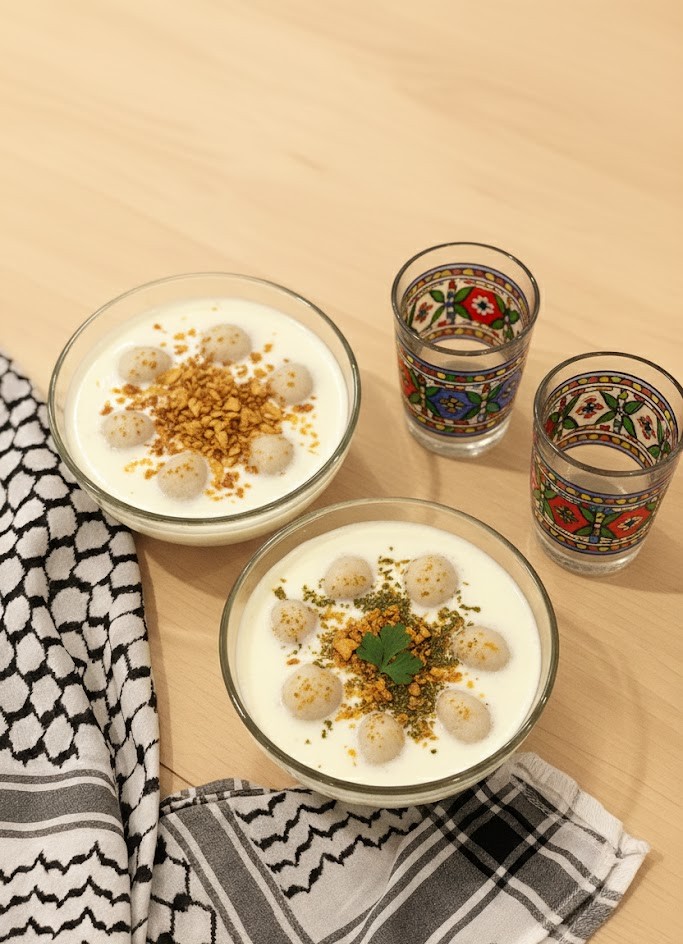
The Shish Barak is a dialectical artifact. It is a borrowed form (the Ottoman military cap) filled with an indigenous substance (local ingredients and Palestinian ingenuity). The act of co-option and transformation precipitates a fundamental philosophical query: Can Cultural Synthesis be an act of National Resistance?
The Palestinian genius lies in achieving dynamic permeability—a state of being interactive and flexible at the same time (open to external influence) while simultaneously defending the ontological core of its originality.
The Wisdom of TETA (the Palestinian Grandmother)
This is the wisdom of the Palestinian Grandmother (Teta): a pragmatic philosophy that navigated the tension between the Universal (the interactive human sphere) and the Particular (the national commitment), proving that cultural exchange does not necessitate cultural surrender.
Palestine, in this view, functions as an active historical crucible that continuously recasts the contributions of the Islamic armies into its own enduring legacy, thereby achieving a form of cultural invincibility via structural integration with the varied Islamic cultures.
The dish itself has wandered across Anatolia, Central Asia, and the Levant, adapting to each land it visited, absorbing new flavors and new souls. In every place it stopped, it borrowed a spice, a habit, a gesture—until it finally found its voice in Palestine. There, in Teta's kitchen, the Shish Barak became something more intimate. She honoured its roots yet made it her own: adding ghee, coriander and garlic, infusing it with the fragrance of her land, and sprinkling over it the taste of her soil—the pulse of her fields and the softness of her rain.
A Symbol of Resilience
Though its name carries Ottoman echoes, as it resembles the Ottoman military head-wear, its essence in Palestine became deeply local—a meeting of history, geography, and agriculture in one humble bowl. In that transformation lies a quiet kind of genius: the ability to belong everywhere, to speak many culinary languages, and to still taste like home.
Shish Barak tells a story of cultural grace—of women who, through the art of cooking, have woven bridges between times, peoples, and cultures. In the hands of the Palestinian Teta (grandmother), it becomes a symbol of openness and resilience, proof that tradition is not rigidity, but the tender art of adaptation.
In the end, Shish Barak is more than nostalgia—it is a traveler with stories to tell.
Shish Barak is more than food. It is the warmth of dawn, the whisper of the earth, and the echo of generations—a living memory simmered in yogurt and love.